 |
food poverty |
|---|
 |
Inequality kills chance for healthy school meal
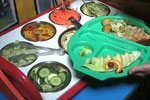 Stigma and rising meal costs are forcing poor children to miss out on healthy school lunches, according to a leading charity.
One in five pupils aged five to 16 failed to take up their free school meal according to the latest results from the Local Authority Caterer’s Association (LACA).
Food poverty has been loosely described by campaigners as the ‘inability to obtain healthy food.’
Chief Executive of the Child Poverty Action Group (CPAG) Kate Green believes free healthy school food is vital to avoid “isolating” and “stigmatising” experiences in young children.
“If you are on a low income you are going to struggle to feed your family as healthily as you like…that’s why it’s important that meals that are on offer at school are of a decent quality.”
 Whose to blame for poverty? Find out Kate Green’s assessment of child poverty in the UK. (Dur: 45secs)
Stigma
“Lunchtime apartheid” is increasing stigma on children receiving free school meals, says parents.
The idea that poverty exists in our ‘backyard’ increases stigma for children receiving free school meals.
Merton parents for better food in school in Wimbledon carried out a dining room competition where children could put forward suggestions for improvements.
Press officer Jackie Schneider told how children said they were divided by age, hot meal or pack lunch and had to queue for long periods for their food.
Children on free school meals said they often have to queue up separately or wait until those paying have been served.
“The lunchtime and the playtimes are when the children feel in control and if they can’t play with their friend……they often vote to swap or do what their friend is doing,” added Mrs Scneider.
Not everyone agrees that stigma is a big issue though.
Rose Wear, 16, from Redborne upper school in Bedfordshire has had free meals for most of her time at school.
“There are so many people that have school dinners. Everyone is aware of each others circumstances and is not going to have a pop at someone because they have a free school meal.
“It’s not an issue; you just get on with it.”
Sums don’t add up
There were just over one million free school meals vouchers available last year to families on certain benefits.
Housing charity Shelter says there are 1.8 million children living in severe poverty in the UK with 3.8 million classed as poor according to CPAG.
The number of children living in poverty since 1999 has fallen by 600,000 but the government has a long way to go to reach their targets to eliminate child poverty by 2020.
Mrs Green said that the government needs to have an all round approach to the problem.
“You need to ensure families have enough money, schools giving best chance to every child despite their background, housing is adequate, warm, dry, comfortable and safe,” she added.
Trial and error
Primary school pupils in Hull with no longer receive free school meals after the council decided to axe the pilot scheme.
The council’s 2004 initiative in tackling children’s diet was welcomed by campaigners and saw school meal uptake double to nearly 65%.
The new liberal democrat council voted to scrap the plans by this September arguing the cost of three million pounds was too much of a burden.
CPAG’s Kate Green said: “The cost to society if children are not getting healthy meals is much higher; their health is going to suffer and there is an impact on costs the NHS face.”
Councils and caterer found the new rules difficult.
These changes have been met in part by the government but the price is still going up; in 2006 the average cost of a school meal was £1.64 (LACA).
.Click here to check out the school meal timeline.
Poor and healthy?
Socially disadvantaged children eat less well and eat more junk food according to studies by the University of Dublin.
Professor Kelleher found they are more likely to suffer from coronary heart disease, tooth decay and rickets.
The total amount of junk food eaten was 17% of a rich person’s diet in contrast to 40% by ‘poor’ people.
Tim Varney, a vending operator from Wiltshire, doesn’t believe that healthy food costs more and that the problem lies elsewhere.
“What we actually need to encourage is eating less because we eat too much, some of that is because of the salt and sugar content in the processed foods that we go back for more,” he added.
The Food Standards Agency found that the type of food eaten by those on lower incomes didn’t vary too much from other groups.
The Low Income and Nutrition Survey (2007) found the biggest exceptions to be in higher volumes of artificial sugars and saturated fat.
Barnardo’s is one of many charities that link diet and income and want the government to implement better strategies and increase tax credits.
Gordon Brown announced an extra £1bn spending on tax credits this year but critics claim it will still leave one million children in poverty by 2010.
“The figures are very depressing and a disgrace from such a rich country,” said a Barnardo’s spokesperson.